Pallet Types & Products
From stringer pallets to block pallets, hardwood to softwood, new to recycled — we stock and supply every pallet type your operation needs. Serving Phoenix and the entire Southwest region.
Request a Quote
Fill out the form and our team will get back to you within 24 hours with a customized quote.
Understanding Pallet Types
Selecting the right pallet type is critical for safe, efficient shipping and storage. Each design has distinct advantages depending on load weight, handling equipment, storage conditions, and whether the pallet will be used domestically or for international export.
Stringer Pallets
The most common pallet design in North America. Stringer pallets use two or three parallel pieces of lumber (stringers) to support the deck boards. They offer a cost-effective solution for most warehousing and shipping applications. The stringers run the full length of the pallet and provide structural support, while notched cutouts along each stringer allow fork entry from two or four sides depending on the configuration.
Key Features
- 2-way or 4-way partial fork entry
- Lower cost than block pallets
- Easy to repair and recycle
- Ideal for standard warehouse racking
Block Pallets
Block pallets use solid wood blocks between the top and bottom deck boards, typically nine blocks arranged in a 3x3 pattern. This design provides true 4-way fork entry from all sides, making them the preferred choice for high-volume distribution centers and automated material handling systems. Block pallets are generally stronger and more durable than stringer pallets, and they distribute weight more evenly across the deck surface.
Key Features
- True 4-way fork entry
- Higher load capacity
- Superior durability and longer lifespan
- Compatible with automated systems
Hardwood Pallets
Constructed from dense hardwood species such as oak, maple, birch, and hickory, hardwood pallets deliver exceptional strength and load-bearing capacity. Hardwoods have a higher density and tighter grain structure, which means they resist impact damage, splitting, and surface wear better than softwoods. They are the go-to choice for heavy loads, export shipments, and applications where the pallet will be reused many times over.
Key Features
- Higher static and dynamic load capacity
- Excellent resistance to damage and wear
- Longer service life with proper maintenance
- Ideal for heavy industrial loads
Softwood Pallets
Made from pine, spruce, fir, and other coniferous species, softwood pallets are the workhorse of the pallet industry. They are lighter weight, easier to handle, and more cost-effective than hardwood alternatives. Softwoods accept heat treatment and chemical treatment more readily, making them an excellent choice for international shipping that requires ISPM-15 compliance. Their lighter weight also reduces transportation costs.
Key Features
- Lightweight and easier to handle
- More affordable than hardwood
- Readily accepts heat treatment (ISPM-15)
- Lower transportation costs due to weight
Heat-Treated (HT) Pallets
Heat-treated pallets have been processed in a kiln to reach a core temperature of 56 degrees Celsius for a minimum of 30 minutes, as required by the International Standards for Phytosanitary Measures No. 15 (ISPM-15). This process eliminates insects, larvae, and pathogens that could spread across international borders. Every heat-treated pallet receives an official IPPC stamp certifying compliance. These pallets are mandatory for international shipping to most countries.
Key Features
- ISPM-15 certified for international shipping
- Free from pests and pathogens
- Accepted at all international ports
- Stamped with IPPC compliance mark
New vs. Recycled Pallets
Choosing between new and recycled pallets depends on your application, budget, and sustainability goals. New pallets offer uniform dimensions and pristine condition, making them ideal for automated systems and food-grade applications. Recycled pallets deliver the same structural performance at 30 to 50 percent lower cost and significantly reduce environmental impact. At Phoenix Pallet Recycling, we inspect and grade every recycled pallet to ensure it meets strict quality standards.
Key Features
- Recycled pallets save 30–50% over new
- Recycled pallets reduce landfill waste
- New pallets offer exact dimensional consistency
- Both options available in all sizes
Product Resources
Dive deeper into our product catalog with detailed size guides, grading information, and accessories for your pallet needs.
Pallet Size Guide
Comprehensive reference of all standard US and international pallet sizes, dimensions, weight capacities, and industry-specific recommendations.
View size guidePallet Grades
Understand our grading system — Grade A premium, Grade B standard, and Grade C economy — and learn which grade is the right fit for your operation.
View gradesAccessories & Custom Products
Pallet collars, covers, corner protectors, dunnage, and custom wood products crafted from recycled pallet lumber.
View accessoriesPallets for Every Industry
Food & Beverage
Heat-treated, food-grade pallets that meet FDA and FSMA requirements for safe food contact and transport.
Pharmaceutical
Clean, Grade A pallets with precise dimensions for automated warehouse systems and regulatory compliance.
Manufacturing
Heavy-duty hardwood pallets rated for high static loads and repeated forklift handling in production facilities.
Retail & E-Commerce
Cost-effective recycled pallets for one-way shipping, display pallets, and high-volume distribution centers.
Pallet Anatomy 101
Understanding the individual components of a pallet helps you make smarter purchasing decisions, communicate repair needs clearly, and evaluate pallet quality with confidence. Here is every part of a standard wood pallet, what it does, and why it matters.
Top Deck Boards
The horizontal boards on the upper surface of the pallet where products are placed. Standard top decks use 5 to 7 boards, each typically 3.5 to 6 inches wide and 5/8 to 3/4 inch thick. Board spacing matters: gaps wider than 3.5 inches can cause small packages to fall through, while tighter spacing distributes weight more evenly across the load. Top deck boards take the most abuse from fork tines, product edges, and stacking pressure, so their condition is a primary factor in grading.
Bottom Deck Boards
The horizontal boards on the underside of the pallet that contact the floor, racking, or conveyor surface. Most pallets have 3 bottom boards — one along each edge and one in the center. Bottom boards are typically the same thickness as top boards but may be narrower (3 to 4 inches wide). They prevent the stringers from rocking on flat surfaces and distribute the pallet weight across racking beams. Missing or cracked bottom boards cause instability on conveyors and can lead to catastrophic rack failures.
Stringers
The long structural members that run the full length of a stringer pallet, connecting the top and bottom deck boards. Standard stringers are 2x4 lumber (actual 1.5 x 3.5 inches) and are the primary load-bearing element. A typical pallet has 3 stringers: one on each edge and one in the center. Notches cut into the stringers at regular intervals allow forklift fork entry. The center stringer is the most critical — if it cracks, the pallet loses roughly 50% of its load capacity.
Blocks
Solid wood cubes (typically 3.5 x 3.5 x 3.5 inches) used in block pallets instead of full-length stringers. A standard block pallet uses 9 blocks arranged in a 3x3 grid, connected by short stringer boards running between them. Block construction provides true 4-way fork access from all sides and distributes compression loads more evenly than stringers. Blocks are made from hardwood or compressed wood fiber and rarely crack, making block pallets generally more durable.
Lead Boards
The outermost top and bottom deck boards at each end of the pallet. Lead boards take the heaviest impact from forklift entry and are the first boards to show damage. On a quality pallet, lead boards are often thicker (sometimes 3/4 inch instead of 5/8 inch) or made from harder wood species than interior boards. Inspectors pay special attention to lead boards during grading because they are the most common failure point. A pallet with cracked lead boards should not be used on racking systems.
Notches & Fork Entry
Rectangular cutouts in the stringers (typically 9 inches wide by 1.5 inches deep) that allow forklift forks to slide under the top deck. A 2-way pallet has notches on both ends; a partial 4-way pallet adds notches along the sides as well. The notch dimensions must match standard fork tine widths (4 to 6 inches), and the opening must be at least 3.25 inches tall for proper fork clearance. Damaged or undersized notches cause forks to jam, increasing handling time and the risk of pallet breakage.
Chamfers
Angled cuts on the bottom edges of the lead boards or stringer ends that create a tapered entry point for pallet jacks and forks. Chamfers reduce the chance of a fork tip catching on the pallet edge during insertion. A standard chamfer is cut at a 45-degree angle, removing approximately 3/4 inch of material. Pallets used in automated systems almost always require chamfers, because robotic handling equipment relies on smooth, consistent entry geometry to avoid jams on conveyor lines.
Fasteners (Nails & Screws)
The hardware that holds the pallet together. Most pallets are assembled with helically threaded (spiral shank) or ring-shank nails, which resist withdrawal 40% better than smooth-shank nails. A standard 48x40 pallet uses 60 to 80 nails. Nail length typically ranges from 2.25 to 2.5 inches for deck-to-stringer connections. Protruding nails are a common safety hazard and an automatic downgrade to Grade B or C. Some specialty pallets use screws for higher pull-out resistance, though this increases assembly cost by 25 to 35%.
Deckboard Spacing
The gaps between individual top deck boards, typically ranging from 1 to 3.5 inches depending on design and application. Tighter spacing (1 inch or less) is required for small items, automated systems, and food-grade applications. Wider spacing (up to 3.5 inches) saves lumber and reduces weight but limits what can be placed on the pallet. GMA-standard 48x40 pallets use 7 top boards with approximately 2.75-inch gaps — wide enough for airflow in cold storage but narrow enough for most carton sizes.
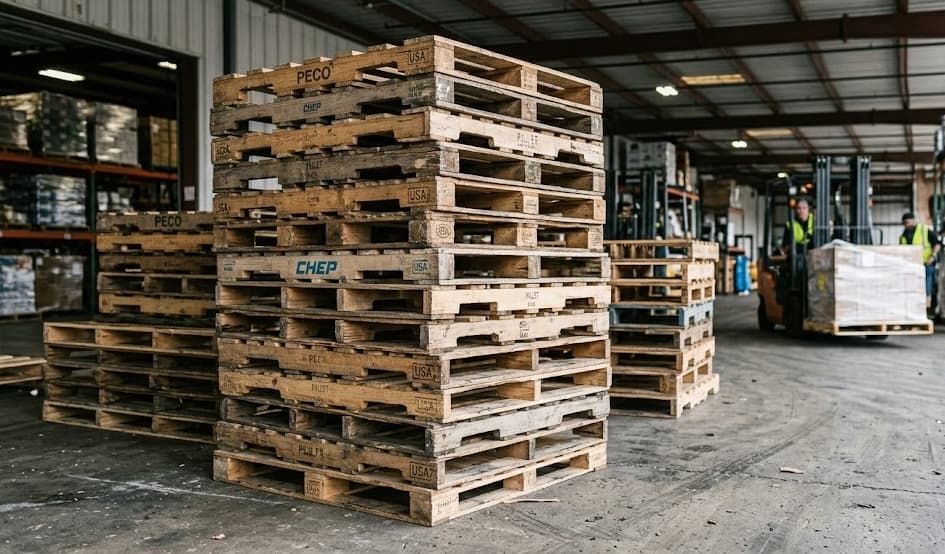
Every pallet we process is inspected, sorted, and graded before it reaches your facility.
New vs. Recycled: A Side-by-Side Comparison
The new-versus-recycled decision impacts your budget, your sustainability goals, and your operational efficiency. Here is a transparent, data-driven comparison to help you choose.
| Factor | New Pallets | Recycled Pallets |
|---|---|---|
| Unit Cost (48x40) | $12 — $22 per pallet depending on lumber market | $5 — $12 per pallet; Grade A at top, Grade C at bottom |
| Environmental Impact | Requires harvesting new timber; 1 new pallet uses approximately 12 board feet of lumber from managed forests | Diverts 30+ lbs of wood waste from landfill per pallet; extends wood fiber life by 5 to 10 additional cycles |
| Carbon Footprint | Higher — includes logging, milling, kiln drying, and transport of raw lumber to the pallet manufacturer | 60 to 80% lower carbon footprint than new; local sourcing eliminates long-distance raw material transport |
| Structural Strength | Consistent, uniform strength across all boards; full rated capacity guaranteed on every unit | Grade A recycled performs within 5% of new; Grade B within 10%; Grade C may have 15-20% reduced capacity |
| Availability | Subject to lumber market supply; lead times of 1 to 3 weeks during peak demand periods | Typically in stock; Phoenix Pallet Recycling maintains 15,000+ units in inventory for same-day or next-day pickup |
| Lead Time | 3 to 10 business days for standard orders; custom sizes may take 2 to 4 weeks | Same-day pickup for in-stock sizes; 1 to 3 days for graded and sorted bulk orders |
| Customization | Fully customizable — any size, wood species, board count, treatment, and branding | Limited to available inventory dimensions; custom sorting and selection available for bulk orders |
| Dimensional Consistency | Tolerances within 1/8 inch; ideal for automated material handling and AS/RS systems | Grade A within 1/4 inch; Grade B within 1/2 inch; may require manual sorting for tight-tolerance applications |
| Appearance | Clean, uniform color; no stains, marks, or wear; ideal for customer-facing and retail environments | Varies by grade; Grade A is visually clean, Grade B may show minor wear, Grade C shows clear signs of prior use |
| Sustainability Reporting | Contributes to FSC/PEFC chain-of-custody certification if sourced from certified forests | Counts toward waste diversion, circular economy, and Scope 3 emissions reduction goals in ESG reporting |
The Bottom Line
For most businesses, Grade A or Grade B recycled pallets deliver identical performance to new pallets at 30 to 50% lower cost. The primary exceptions are fully automated AS/RS warehouses that require sub-1/8-inch tolerances, applications with strict cosmetic requirements, and custom sizes not available in recycled inventory. At Phoenix Pallet Recycling, roughly 85% of our customers choose recycled pallets for their primary operations and reserve new pallets for specialty applications.
Wood Species Guide for Pallets
The wood species used in a pallet determines its weight, strength, moisture resistance, and cost. Understanding the properties of each species helps you match the right pallet to your specific application and environment — especially in Arizona, where heat and low humidity create unique challenges.
Know Your Wood
Species selection affects strength, weight, and cost
Why Wood Species Matters
The species of wood used in pallet construction directly impacts load capacity, durability, weight, and cost. Hardwoods like oak and maple offer superior strength for heavy loads, while softwoods like pine and spruce provide a lighter, more economical option for standard shipping. In Arizona's dry climate, moisture content stays naturally low, which benefits all species but particularly enhances softwood performance.
Hardwood
2,500+ lb capacity, 15-20 use cycles
Softwood
1,500+ lb capacity, 5-8 use cycles
Southern Yellow Pine
Janka Hardness: 690 lbf — Softwood | Approx. 35 lbs per pallet (48x40)
The most commonly used pallet wood in the United States. Southern Yellow Pine (SYP) accounts for nearly 50% of all pallets manufactured domestically. It is affordable, widely available from southeastern U.S. mills, and accepts heat treatment and chemical treatment readily. SYP is the go-to choice for ISPM-15 export pallets.
Moisture Resistance
Moderate moisture resistance; requires treatment for prolonged outdoor use. Absorbs and releases moisture faster than hardwoods, which can cause warping in high-humidity environments but performs well in Arizona's dry climate.
Availability in Arizona
Excellent performance in Arizona. The dry climate keeps moisture content low (6 to 8%), which actually increases the wood's strength. SYP pallets stored outdoors in Phoenix will experience surface checking (small cracks) from UV exposure but maintain structural integrity for years.
Oak (Red & White)
Janka Hardness: 1,290 lbf (Red) / 1,360 lbf (White) — Hardwood | Approx. 55 to 65 lbs per pallet (48x40)
The premium choice for heavy-duty pallets carrying loads over 3,000 lbs. Oak pallets are standard in the automotive, steel, and heavy manufacturing industries. A well-built oak pallet can complete 15 to 20 use cycles before needing repair, compared to 5 to 8 cycles for pine. White oak is preferred for chemical and outdoor applications due to its superior moisture resistance.
Moisture Resistance
White oak has exceptional moisture resistance due to tyloses that block the wood pores, making it nearly waterproof. Red oak is more porous and susceptible to moisture damage. Both species resist rot better than softwoods.
Availability in Arizona
Oak is less common in the Arizona pallet market because it must be sourced from eastern U.S. forests, adding transportation cost. However, its density and hardness make it the best choice for heavy loads in Phoenix-area manufacturing and distribution facilities. Oak resists the impact damage from aggressive forklift handling better than any other species.
Hard Maple
Janka Hardness: 1,450 lbf — Hardwood | Approx. 60 to 70 lbs per pallet (48x40)
Hard maple is one of the densest and strongest North American hardwoods, making it ideal for pallets that support extremely heavy loads — engine blocks, steel coils, industrial machinery, and military equipment. Maple pallets are also used in food processing because the wood's tight grain structure resists absorption of oils and contaminants.
Moisture Resistance
Moderate moisture resistance. Maple is susceptible to staining from moisture contact but resists structural damage from intermittent wetting. In Arizona's dry climate, moisture is rarely a concern.
Availability in Arizona
Limited local availability. Maple is sourced primarily from the northeastern U.S. and upper Midwest. Cost-effective only for specialized heavy-load applications where no other species will suffice. When available in recycled inventory, maple pallets command a premium.
Spruce / Fir (SPF)
Janka Hardness: 490 to 590 lbf — Softwood | Approx. 30 to 35 lbs per pallet (48x40)
SPF lumber is a staple of the Canadian and northern U.S. pallet industry. It is lightweight, easy to nail without splitting, and very cost-effective. SPF pallets are preferred for lightweight consumer goods, electronics, and any application where reducing pallet weight is a priority. The light color of spruce also gives pallets a cleaner appearance.
Moisture Resistance
Low moisture resistance compared to other species. Spruce and fir are susceptible to fungal growth in humid environments but perform well in dry climates. Both species dry quickly and maintain dimensional stability once seasoned.
Availability in Arizona
Good availability through recycled channels. SPF pallets arriving in Phoenix from Canadian and northern U.S. supply chains are readily collected and recycled. The wood performs well in Arizona's dry heat, though it is softer and more prone to fork damage than pine or hardwoods.
Poplar / Cottonwood
Janka Hardness: 540 lbf — Hardwood (classified, but relatively soft) | Approx. 38 to 45 lbs per pallet (48x40)
Poplar occupies a middle ground between softwoods and true hardwoods. It is technically a hardwood but has a lower density and hardness closer to softwoods. Poplar pallets are used for moderate-weight loads where some additional strength over pine is needed but the weight and cost of oak are not justified. Common in the furniture, paper, and general manufacturing industries.
Moisture Resistance
Poor moisture resistance. Poplar absorbs water readily and is highly susceptible to decay in wet conditions. However, it dries quickly and performs adequately in covered or indoor environments.
Availability in Arizona
Moderately available in the Phoenix recycled pallet supply. Poplar grows throughout the eastern U.S. and arrives in Arizona on inbound freight. It performs adequately in the dry climate but is more susceptible to splitting from rapid moisture loss than denser species. Best suited for indoor or covered applications.
How Pallets Are Made
Whether new or recycled, every pallet goes through a precise manufacturing and assembly process. Understanding how pallets are built helps you appreciate the engineering behind this deceptively simple product and why quality varies so widely across suppliers.
Lumber Selection & Grading
The process begins with raw lumber selection. New pallet manufacturers source green (freshly cut) or kiln-dried lumber from sawmills. The lumber is graded for structural defects — knots larger than 1/3 the board width, wane (bark edge), splits, and rot are all evaluated. For recycled pallets, this step involves sorting incoming used pallets and dismantling those beyond repair to salvage usable boards. At Phoenix Pallet Recycling, we recover approximately 70% of the lumber from every decommissioned pallet.
Cutting to Dimension
Lumber is cut to precise lengths and widths on industrial cut-off saws and rip saws. A standard 48x40 stringer pallet requires deck boards cut to 40 inches and stringers cut to 48 inches. Tolerances at this stage are critical — boards must be within 1/16 inch of target length to ensure the finished pallet meets dimensional specifications. Modern pallet plants use automated lumber feeders that process 15 to 20 boards per minute.
Notching (Stringer Pallets)
For stringer pallets, each stringer is run through a notching machine that cuts the fork-entry openings. Standard notches are 9 inches wide, 1.5 inches deep, and positioned to create a 3.25-inch-tall fork clearance. A 4-way partial entry pallet receives notches on both the ends and the center of each stringer. The notching must be precise — oversized notches weaken the stringer, while undersized notches prevent proper fork entry.
Assembly & Nailing
The cut lumber is assembled in a nailing jig — a metal fixture that holds boards in exact position during fastening. Pneumatic nail guns drive helically threaded nails at a rate of 2 to 3 nails per second. Each deck board receives 2 nails at every stringer intersection (6 nails per board on a 3-stringer pallet). A skilled operator or automated nailing machine can assemble 120 to 180 pallets per hour. Nail depth, angle, and spacing are all controlled to prevent splitting and ensure pull-out resistance.
Chamfering & Finishing
After assembly, lead board edges may be chamfered on a belt sander or router table to create the angled entry surface for forks and pallet jacks. Some pallets also receive branding stamps, customer logos, or tracking barcodes at this stage. For recycled pallets, finishing includes removing protruding nails, sanding rough edges, and verifying dimensional accuracy with go/no-go gauges.
Heat Treatment (If Required)
Pallets destined for international shipping enter a sealed kiln chamber where the wood core temperature reaches 56 degrees Celsius (132.8 degrees Fahrenheit) and holds for a minimum of 30 minutes. Temperature probes embedded in sample pallets verify compliance. After treatment, each pallet receives an IPPC stamp with the facility certification number, country code, and treatment method (HT for heat treatment). Our Phoenix facility is a certified ISPM-15 heat treatment provider.
Quality Inspection & Stacking
Every finished pallet passes through a final inspection station where it is checked for protruding nails, cracked boards, dimensional accuracy, and overall structural integrity. Pallets that pass inspection are sorted by grade (for recycled) or by customer order (for new), then stacked in units of 15 to 20. Stacked pallets are banded with steel or poly strapping for transport. Rejected pallets are sent back to the repair line or dismantled for lumber recovery.
Inventory & Delivery
Finished pallets are stored in our outdoor yard, organized by size, grade, and treatment status. We maintain a running inventory of over 15,000 pallets across all standard sizes at our Phoenix facility. Delivery is available via our own flatbed trucks for the greater Phoenix metropolitan area, or pallets can be loaded onto customer trucks for pickup. Standard delivery lead time is same-day to next-business-day for in-stock items.
Pallet Lifecycle: From Forest to Recycling
A wood pallet is one of the most recycled consumer products in the world. The United States produces approximately 500 million new pallets per year, and over 95% of them are recovered and recycled at least once. Here is the full journey with real industry statistics at every stage.
Forest & Harvest
6.3 billion board feet
of lumber used for pallets annually in the U.S.
Pallet lumber is primarily sourced from managed forests and sawmill byproducts. Approximately 40% of all U.S. hardwood lumber production and 15% of softwood production goes to pallet manufacturing. Trees are harvested from sustainably managed stands, and lower-grade logs (those unsuitable for furniture or construction) are diverted to pallet mills. The pallet industry is actually a critical market for low-grade timber — without it, forest management would become economically unviable in many regions.
Manufacturing
500+ million
new wood pallets produced in the U.S. per year
The U.S. has approximately 3,000 pallet manufacturing facilities, ranging from small family operations to large automated plants producing 2,000+ pallets per day. Manufacturing consumes roughly 12 board feet of lumber per standard 48x40 pallet. The process generates 10 to 15% wood waste in the form of sawdust, bark, and offcuts, which is typically sold for mulch, animal bedding, or biomass energy production.
First Use & Distribution
2 billion
pallets in active circulation across the U.S.
Once manufactured, pallets enter the supply chain carrying goods from manufacturers to distributors to retailers. A pallet's first trip typically covers 500 to 1,500 miles by truck. At the destination, the pallet is unloaded, and the goods are distributed. The average pallet makes 3.5 one-way trips before it needs repair and 7 to 10 trips before it is decommissioned. During its active life, a single 48x40 pallet carries an estimated $100,000 to $500,000 worth of goods.
Collection & Sorting
95%+
of wood pallets are recovered, not landfilled
Used pallets are collected by recyclers like Phoenix Pallet Recycling from retailers, manufacturers, and distribution centers. Our trucks collect used pallets from over 200 business locations across the greater Phoenix area. At our facility, pallets are sorted by size and condition. Approximately 50% are reusable as-is (requiring only inspection), 35% need minor to moderate repair, and 15% are dismantled for lumber recovery. The U.S. pallet recycling industry recovers an estimated 474 million pallets annually.
Repair & Refurbishment
326 million
pallets repaired and returned to service annually
Pallets that need repair have damaged boards removed and replaced with reclaimed lumber from dismantled pallets. A typical repair takes 90 seconds to 3 minutes and replaces 1 to 3 boards. Repaired pallets are re-graded and returned to inventory. The repair process consumes 80% less energy and 85% less raw material than manufacturing a new pallet, making it one of the most resource-efficient industrial recycling processes in existence.
End of Life
3.9 million tons
of pallet wood recycled into other products yearly
When a pallet can no longer be economically repaired, its lumber is recovered and given a second life. Pallet wood is ground into landscape mulch (the single largest end market), processed into animal bedding, chipped for biomass energy generation, or upcycled into custom wood products like the garden beds and display stands we craft at Phoenix Pallet Recycling. Less than 5% of pallet wood ends up in landfills — a recovery rate that far exceeds most other packaging materials. The EPA estimates that wood pallet recycling diverts over 26 million tons of waste from landfills each year.
By choosing recycled pallets from Phoenix Pallet Recycling, you are participating in one of the most successful circular economies in the world. Every pallet we repair and return to service saves approximately 12 board feet of new lumber, diverts 30+ pounds of wood from landfill, and reduces carbon emissions by an estimated 4.7 kg CO2 equivalent compared to manufacturing a new pallet.