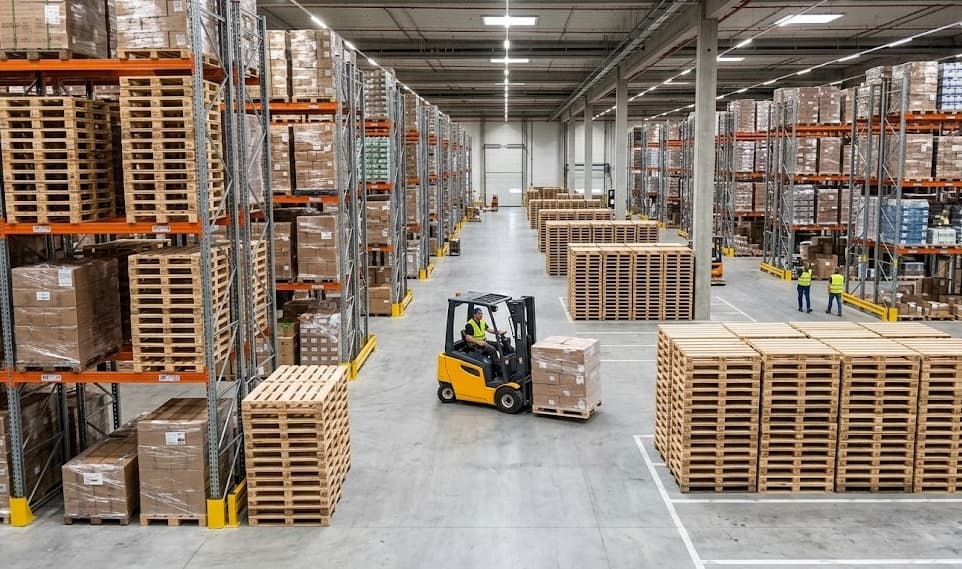
Pallet Size Guide
The most comprehensive pallet dimension reference available. Find the exact size, weight capacity, and application data for every standard pallet used in domestic and international shipping.
Request a Quote
Fill out the form and our team will get back to you within 24 hours with a customized quote.
Choosing the Right Pallet Size
The pallet size you select directly impacts shipping costs, warehouse efficiency, product safety, and supply chain performance. A pallet that is too small risks product overhang and damage; one that is too large wastes trailer space and increases freight costs. The right size optimizes your entire logistics operation.
Trailer Optimization
Standard US trailers are 96 inches wide internally. Two 48x40 pallets fit perfectly side by side, maximizing load density and reducing per-unit shipping costs.
Rack Compatibility
Warehouse racking systems are designed around specific pallet dimensions. Using the wrong size means pallets won't seat properly in beam racks, creating safety hazards.
Weight Distribution
Larger pallets distribute weight across more deck surface, reducing point loading. Match pallet size to your product weight to prevent deck board failure.
Standard US Pallet Sizes
The following sizes represent the most commonly used pallet dimensions in the United States. The 48x40 GMA pallet accounts for roughly 30% of all new wood pallets produced in the country each year.
| Size (L x W) | Common Name | Common Uses |
|---|---|---|
| 48" x 40" | GMA / Grocery | Grocery, general retail, consumer goods, warehousing |
| 42" x 42" | Telecom / Paint | Telecommunications, paint cans, square footprint loads |
| 48" x 48" | Drum / Barrel | 55-gallon drums, barrels, bulk chemicals, large square loads |
| 48" x 42" | Military / Automotive | U.S. military, automotive parts, chemical industry |
| 40" x 40" | Dairy Industry | Dairy products, smaller square footprint loads |
| 48" x 36" | Beverage | Beverage industry, canned goods, bottled drinks |
| 36" x 36" | Small / Compact | Small loads, point-of-sale displays, tight storage areas |
| 48" x 45" | Automotive | Automotive industry, large component shipping |
| 44" x 44" | Chemical / Drum | Chemical drums, agricultural products, square loads |
| 60" x 48" | Oversized | Large machinery, bulky freight, industrial equipment |
| 60" x 60" | Extra-Large | Heavy industrial, HVAC equipment, large assemblies |
* Weight capacities shown are typical values for standard-grade pallets. Actual capacity depends on pallet grade, wood species, moisture content, and load distribution. Contact us for load-specific recommendations.
International Pallet Sizes
If you ship goods internationally, you need pallets that comply with destination-country standards. The ISO 6780 specification recognizes six standard pallet sizes for international trade. ISPM-15 heat treatment is required for all wood pallets crossing international borders.
800 x 1200 mm
(31.5" x 47.2")
EUR / EPAL (Euro Pallet)
European trade, most common international pallet worldwide
1000 x 1200 mm
(39.4" x 47.2")
ISO / EUR2
European and Asian trade, larger European standard
1165 x 1165 mm
(45.9" x 45.9")
Australian Standard
Australian domestic trade, fits standard Australian trucks
1100 x 1100 mm
(43.3" x 43.3")
Asian Standard
Japan, Korea, and wider Asia-Pacific trade
1067 x 1067 mm
(42" x 42")
North American / Asia
Cross-regional trade between North America and Asia
1100 x 1400 mm
(43.3" x 55.1")
European Large
Large European freight, heavy industrial goods
Industry-Specific Recommendations
Different industries have standardized around specific pallet sizes for regulatory, logistical, and operational reasons. Here is what we recommend based on your sector.
Grocery / FMCG
Primary size: 48" x 40"
The Grocery Manufacturers Association (GMA) pallet is the undisputed standard. Fits standard US trailer widths (two pallets across at 96 inches). Required by most major retailers and distribution centers.
Pharmaceutical
Primary size: 48" x 40" or 40" x 40"
Strict dimensional tolerances required. Grade A pallets preferred. Must be clean, free of contaminants, and often heat-treated. Some facilities require plastic or metal pallets for cleanroom environments.
Chemical & Petrochemical
Primary size: 48" x 48" or 44" x 44"
Square pallets for drum storage. Must support heavy loads (55-gallon drums weigh up to 500 lbs each). Spill containment pallets may be needed for hazardous materials.
Automotive
Primary size: 48" x 45" or 48" x 42"
Automotive parts require consistent dimensions for automated assembly lines. Returnable pallet programs are common. Heavy-duty construction for engine blocks and transmissions.
Beverage
Primary size: 48" x 36"
Narrower width accommodates standard beverage can and bottle case dimensions. High dynamic load capacity needed for heavy liquid loads. Floor-stacking strength is critical.
Export / International
Primary size: 800 x 1200 mm (EUR)
ISPM-15 heat treatment is mandatory. Euro pallets are the global standard for international trade. Ensure pallets carry the IPPC stamp. Some countries require fumigation certificates.
How to Choose the Right Pallet Size
Measure Your Product
Start by measuring the footprint of your product or the outer dimensions of its packaging. The pallet should be equal to or slightly larger than the product base — never smaller, as overhang causes damage and creates safety hazards during handling.
Check Your Trailer
Standard US dry van trailers have an internal width of 96 to 98.5 inches. Two 48-inch pallets fit across perfectly. If you use a non-standard trailer (reefer, flatbed, intermodal container), measure the internal dimensions and calculate how many pallets fit per row.
Verify Rack Compatibility
If your warehouse uses selective beam racking, pallet flow, push-back, or drive-in systems, confirm the pallet size your racking was designed for. Installing the wrong pallet size can cause rack failures and serious injuries.
Calculate Weight Requirements
Add up the total weight of goods per pallet load, then add a 25% safety margin. Compare against the pallet's rated static and dynamic capacities. If your load exceeds the standard rating, step up to a hardwood or heavy-duty pallet.
Consider Your Supply Chain Partners
Major retailers like Walmart, Costco, and Amazon have strict pallet size requirements — typically the 48x40 GMA standard. Shipping on non-compliant pallets can result in chargebacks, rejected loads, and delayed deliveries.
Factor in Grade Requirements
Once you have the right size, determine the grade you need. Grade A pallets are best for automated systems and premium applications. Grade B works for most general-purpose needs. Grade C offers maximum cost savings for one-way shipments.
Available in All Grades
Every size listed above is available in Grade A, Grade B, and Grade C. Choose the grade that matches your application requirements and budget.
Grade A — Premium
Like-new condition. No major repairs, minimal cosmetic wear. Ideal for automated systems, export, and premium retail.
Learn about Grade ABGrade B — Standard
May have minor repairs and cosmetic wear. Full structural integrity. The best value for most warehouse and shipping needs.
Learn about Grade BCGrade C — Economy
Visible repairs and wear. Fully functional for one-way shipping, temporary storage, and budget-conscious applications.
Learn about Grade CHow to Measure a Pallet Correctly
Pallet dimensions are stated as Length x Width, but the industry convention for which direction is which often trips people up. Measuring incorrectly leads to ordering the wrong size, wasting trailer space, and creating racking incompatibility. Here is the definitive guide to getting it right every time.
Step 1: Identify the Stringer or Block Direction
On a stringer pallet, find the three long boards (stringers) that run underneath the deck boards. The direction the stringers run is the LENGTH of the pallet. On a block pallet, find the short stringer boards connecting the blocks — those run in the LENGTH direction. This is the most common source of confusion: the length is NOT always the longer dimension.
Step 2: Measure the Length (Stringer Direction)
Place your tape measure at one end of a stringer and measure to the opposite end. This is the length. On a standard GMA pallet, the stringers are 48 inches long, so the length is 48 inches. Measure at the stringer level, not at the deck board level, to avoid errors from overhanging or short deck boards.
Step 3: Measure the Width (Deck Board Direction)
Now measure across the deck boards, perpendicular to the stringers. Place your tape measure on the outer edge of one lead board and measure to the outer edge of the opposite lead board. On a standard GMA pallet, the deck boards are 40 inches long, so the width is 40 inches. This gives you the full footprint dimension perpendicular to the stringers.
Step 4: Measure the Height
Pallet height is measured from the floor to the top surface of the top deck boards. Standard pallet height is 6 inches for stringer pallets (using 2x4 stringers with 5/8-inch deck boards) and 5.5 to 6.5 inches for block pallets depending on block size. Height matters for calculating total load height in trailers and rack clearance in warehouses.
Common Measurement Mistakes
- ⚠Swapping length and width — always measure stringer direction first (length), then deck board direction (width). A 48x40 is NOT the same as a 40x48.
- ⚠Measuring damaged pallets — warped or splayed boards give inaccurate readings. Measure at the stringer level for length and at mid-span for width.
- ⚠Forgetting to measure height — especially important if pallets will be used in racking systems with tight beam clearances.
- ⚠Measuring only one side — check all four edges. Recycled pallets may have boards that extend slightly past the stringers. Measure the stringer or block footprint, not protruding boards.
- ⚠Rounding dimensions — a 47.75-inch pallet is NOT a 48-inch pallet for racking purposes. Report exact measurements to the nearest 1/4 inch.
Industry Terminology Quick Reference
Weight Capacity by Pallet Size
Every pallet has three distinct load ratings: static capacity (resting on the floor), dynamic capacity (being lifted and moved by a forklift), and racking capacity (supported only at the edges on warehouse racking beams). Racking capacity is always the lowest because the pallet must span an unsupported gap. These values assume standard-grade softwood construction in good condition.
| Pallet Size | Static Load | Dynamic Load | Racking Load |
|---|---|---|---|
| 48" x 40" | 2,500 lbs | 2,800 lbs | 2,000 lbs |
| 42" x 42" | 2,200 lbs | 2,500 lbs | 1,800 lbs |
| 48" x 48" | 2,800 lbs | 3,500 lbs | 2,200 lbs |
| 48" x 42" | 2,500 lbs | 3,000 lbs | 2,000 lbs |
| 40" x 40" | 2,200 lbs | 2,500 lbs | 1,800 lbs |
| 48" x 36" | 2,200 lbs | 2,500 lbs | 1,600 lbs |
| 36" x 36" | 1,800 lbs | 2,000 lbs | 1,400 lbs |
| 48" x 45" | 2,500 lbs | 3,000 lbs | 2,000 lbs |
| 60" x 48" | 3,000 lbs | 3,500 lbs | 2,200 lbs |
| 60" x 60" | 3,500 lbs | 4,000 lbs | 2,500 lbs |
Static Load
The maximum weight a pallet can support when sitting stationary on a flat, solid surface (like a warehouse floor). Static load is always the highest rating because the weight is fully supported from below.
Dynamic Load
The maximum weight a pallet can carry while being lifted and moved by a forklift or pallet jack. Dynamic loads add stress from acceleration, braking, turning, and uneven surfaces. Use this rating when calculating forklift load limits.
Racking Load
The maximum weight a pallet can support when placed on warehouse racking beams, supported only at its edges. The unsupported center span must bear the full load through the strength of the deck boards and stringers alone. Always the lowest rating.
Which Industries Use Which Pallet Sizes — and Why
Pallet size standardization within an industry is not arbitrary. Each standard emerged from the specific dimensions of the products being shipped, the equipment used to handle them, and the regulatory environment governing that sector.
Grocery & Consumer Packaged Goods
48" x 40" (GMA Standard)
The 48x40 pallet became the grocery standard because two pallets fit perfectly across a standard 96-inch trailer interior, with zero wasted space. The Grocery Manufacturers Association (GMA) formalized this in the 1960s, and it has remained the undisputed standard ever since. Today, major retailers like Walmart, Kroger, Target, and Costco all require 48x40 pallets. Shipping on a non-compliant size can result in chargebacks of $200 to $500 per load, load rejection at the receiving dock, and loss of preferred vendor status.
Chemical & Drum Storage
48" x 48" or 44" x 44"
Standard 55-gallon drums have a 23-inch diameter. A 48x48 pallet accommodates four drums in a 2x2 configuration with proper edge clearance. The 44x44 size is used when drums are slightly smaller (30 or 35 gallon) or when the facility uses specialized drum racking. Square pallets prevent overhang and ensure drums do not extend past the pallet edge — critical for spill containment compliance. Chemical pallets are typically heavy-duty hardwood or block construction because four full 55-gallon drums weigh approximately 2,000 lbs.
Automotive Manufacturing
48" x 45" or 48" x 42"
The automotive industry uses slightly wider pallets than the GMA standard because auto parts — engine blocks, transmissions, body panels — require larger footprints. The 48x45 size fits standard returnable container systems used by the Big Three automakers (GM, Ford, Stellantis) and their tier-1 suppliers. These pallets must meet exacting dimensional tolerances (within 1/8 inch) because they feed automated assembly lines where robotic handlers expect precise pallet geometry. Automotive pallets are almost always hardwood and often include metal reinforcement plates.
Beverage Distribution
48" x 36"
The narrower 36-inch width matches the standard stacking pattern for 12-pack and 24-pack beverage cases. A 48x36 pallet holds 100 to 120 cases of canned beverages in a stable five-layer stack. The narrower width also allows three pallets across in some trailer configurations (36 + 36 + 24 = 96 inches), though two 48x40 pallets is more common. Beverage pallets require extremely high dynamic load capacity because a fully loaded pallet of water or beer can weigh 2,400 to 2,800 lbs.
Pharmaceutical & Medical
48" x 40" or 40" x 40"
Pharmaceuticals default to the 48x40 GMA standard for compatibility with major retail pharmacy and hospital distribution chains. However, many pharmaceutical warehouses use the 40x40 size for smaller, high-value shipments. The pharma industry has the strictest quality requirements of any pallet user: Grade A only, no stains or contamination, heat-treated, dimensional tolerance within 1/4 inch, and complete traceability. Some cleanroom and sterile manufacturing facilities require plastic pallets, but wood pallets are still used for 90% of pharmaceutical distribution.
Telecommunications
42" x 42"
The 42x42 square pallet is the telecom industry standard because the equipment cabinets, cable spools, and hardware panels used in network infrastructure fit naturally on a square platform. This size also became the standard for the paint industry (five-gallon buckets stack efficiently on 42x42) and for some agricultural products. The square footprint provides balanced weight distribution and is compatible with both stringer and block construction.
Dairy Products
40" x 40"
The 40x40 pallet was standardized by the dairy industry because milk crates (13 x 13 inches) stack in a 3x3 pattern that fills this size precisely. The smaller footprint also fits well in the refrigerated walk-in coolers and cold storage rooms typical of dairy distribution. Dairy pallets must be clean and free of contaminants, as they carry food products. They also need to withstand constant exposure to cold (34-38 degrees F) and wet conditions without warping.
International Export
800 x 1200 mm (Euro Pallet) or 1000 x 1200 mm
Export pallets must comply with destination-country standards. The 800x1200mm Euro pallet (also called the EPAL or EUR pallet) is used across all 27 EU member states and is the most common pallet in international trade globally. The 1000x1200mm size is standard across much of Asia. All export pallets must be ISPM-15 heat treated and stamped with the IPPC mark. Phoenix Pallet Recycling is a certified ISPM-15 treatment facility, and we stock Euro pallets and Asian-standard pallets for export customers.
International Shipping Pallet Requirements
Shipping goods across international borders requires pallets that meet the destination country's size standards, treatment requirements, and customs regulations. Using the wrong pallet can result in cargo holds at port, fumigation costs, or complete shipment rejection. Here is what you need to know for each major region.
European Union (EU)
EUR / EPAL — 800 x 1200 mm (31.5" x 47.2")
- ▶The EPAL (European Pallet Association) pallet is mandatory for most European supply chains. It is a 4-way block pallet with 78 nails, 9 blocks, and precise dimensional tolerances codified in EN 13698-1.
- ▶ISPM-15 heat treatment is required for all wood pallets entering the EU. Pallets must display the IPPC stamp with the treatment facility code, country code, and 'HT' designation.
- ▶EU customs authorities actively inspect incoming shipments. Non-compliant pallets are quarantined, fumigated at the shipper's expense (typically $150 to $300 per container), or destroyed.
- ▶Some EU supply chains also accept the EUR2 (1000x1200mm) and EUR3 (1000x1200mm) sizes, but the 800x1200mm is by far the most common and the only universally accepted size.
- ▶EPAL-branded pallets are part of a pooling system with strict quality standards. Generic Euro-sized pallets are acceptable for one-way shipments but may not enter the EPAL exchange pool.
Asia Pacific (Japan, South Korea, China)
1100 x 1100 mm (43.3" x 43.3") — JIS/KS Standard
- ▶Japan and South Korea standardized on the 1100x1100mm square pallet, which fits perfectly into the 2.3-meter-wide containers commonly used in Asian trade. China increasingly adopts this size as well, though 1200x1000mm is also widely used.
- ▶ISPM-15 heat treatment is mandatory. Japan's MAFF (Ministry of Agriculture, Forestry and Fisheries) enforces strict compliance. South Korea requires the KS T 1001 standard in addition to ISPM-15.
- ▶Fumigation with methyl bromide (MB) is still accepted in most Asian countries as an alternative to heat treatment, but MB is being phased out globally and is already banned in the EU. Heat treatment is the safer, future-proof option.
- ▶China requires all imported wood packaging to pass CIQ (China Inspection and Quarantine) inspection. Non-compliant shipments face fumigation, reshipping, or destruction at the port of entry.
- ▶For shipments to multiple Asian countries, the 1100x1100mm pallet provides the broadest compatibility. For China-only shipments, confirm whether your receiver prefers 1100x1100 or 1200x1000.
Australia & New Zealand
1165 x 1165 mm (45.9" x 45.9") — AS 4068
- ▶Australia uses a unique 1165x1165mm square pallet standardized under AS 4068, managed by CHEP Australia. This size fits Australian road transport and warehouse systems but is not compatible with any other international standard.
- ▶ISPM-15 heat treatment is absolutely mandatory. Australia has some of the strictest biosecurity laws in the world (managed by the Department of Agriculture, Fisheries and Forestry). Non-compliant wood packaging is immediately quarantined and fumigated or destroyed.
- ▶Australia requires that all wood packaging material be bark-free in addition to being heat treated. Even small bark remnants can trigger quarantine action.
- ▶New Zealand follows similar rules under the MPI (Ministry for Primary Industries). Both countries require an IPPC stamp and may request treatment certificates as additional documentation.
- ▶For one-way export from the U.S. to Australia, many shippers use standard 48x40 pallets (heat treated) and accept the inefficiency, since return shipping of Australian-size pallets is rarely practical. Confirm with your Australian receiver which approach they prefer.
South America (Brazil, Argentina, Chile)
1000 x 1200 mm (39.4" x 47.2") — PBR Standard
- ▶Brazil uses the PBR (Padrao Brasileiro de Paletes) pallet, a 1000x1200mm 4-way block pallet standardized by ABRAS (Brazilian Supermarket Association). It is dimensionally identical to the EUR2 but follows different construction specifications.
- ▶Argentina, Chile, Colombia, and most other South American countries accept either the 1000x1200mm or 1200x1000mm orientation. The 800x1200mm Euro pallet is less common but accepted for European-origin goods.
- ▶ISPM-15 heat treatment is required across all South American MERCOSUR countries. Brazil's MAPA (Ministry of Agriculture) conducts port inspections and enforces compliance with heavy fines for violations (up to $5,000 USD per container).
- ▶Some Brazilian importers require NIMF-15 compliance certificates in addition to the IPPC stamp. Always request documentation requirements from your Brazilian buyer before shipping.
- ▶For export to South America from Phoenix, we recommend the 1000x1200mm block pallet with ISPM-15 heat treatment. We stock this size and can prepare export-ready pallets within 24 to 48 hours.
Custom Pallet Size FAQ
Not every product fits on a standard 48x40. If you need a non-standard pallet size, here are the most common questions we receive about custom orders, along with honest, detailed answers.
What is the minimum order quantity for custom-sized pallets?
For new custom pallets built to your specifications, our minimum order is 50 units. This threshold covers the setup cost of adjusting our nailing jigs and cutting templates. For recycled pallets in non-standard sizes, there is no minimum — we will pull whatever quantity is available from our recycled inventory. Common non-standard sizes like 48x42, 48x45, and 44x44 are often in stock in recycled form.
How long does it take to receive custom-sized pallets?
Lead time for new custom pallets is typically 5 to 10 business days from order confirmation, depending on complexity and lumber availability. Simple dimension changes (adjusting a 48x40 to a 48x36) can often be turned around in 3 to 5 days. Highly specialized designs with unusual board counts, block configurations, or hardwood species may require 2 to 3 weeks. Recycled non-standard pallets that we have in stock ship same-day or next-day.
What factors affect custom pallet pricing?
Seven primary factors influence price: (1) Dimensions — larger pallets use more lumber. (2) Wood species — hardwood costs 40 to 80% more than softwood. (3) Board count — more deck boards means more material and labor. (4) Lumber thickness — 1-inch boards cost 30% more than 5/8-inch. (5) Treatment — ISPM-15 heat treatment adds $2 to $4 per pallet. (6) Quantity — orders over 200 units receive volume discounts of 8 to 15%. (7) Current lumber market — pallet lumber prices fluctuate 20 to 40% annually based on housing construction demand and timber supply.
Can you match an existing pallet design if I bring a sample?
Yes. Bring a sample pallet to our facility at 4587 W McDowell Rd in Phoenix, and we will reverse-engineer it: measure every dimension, identify the wood species, count board and nail placement, and create a build specification. We can then reproduce that exact design in any quantity. This service is free — we only charge for the pallets we build.
Are there size limits on custom pallets?
Our equipment can build pallets up to 96 inches (8 feet) in either dimension. Beyond that, we move into custom crate territory, which we also offer. On the small end, there is no practical minimum — we regularly build quarter pallets (24x20) for retail displays and half pallets (24x40 or 48x20) for promotional merchandise. Very small pallets (under 20 inches) may require specialty fasteners to avoid splitting, which adds a small surcharge.
Can I get custom pallets with heat treatment for export?
Absolutely. Our Phoenix facility is an ISPM-15 certified heat treatment provider. Every custom pallet we build can be heat treated and stamped with the IPPC mark before delivery. Heat treatment adds $2 to $4 per pallet depending on the batch size. We treat pallets in batches of 40 to 60 units, so timing your order to align with a treatment cycle can reduce lead time.
Do you offer design assistance for custom pallets?
Yes. If you know your product dimensions and weight but are unsure about the optimal pallet design, our team will recommend board count, stringer configuration, wood species, and any reinforcement needed. We have designed custom pallets for products ranging from 50-pound electronics to 8,000-pound industrial transformers. Consultation is free and typically takes one business day.