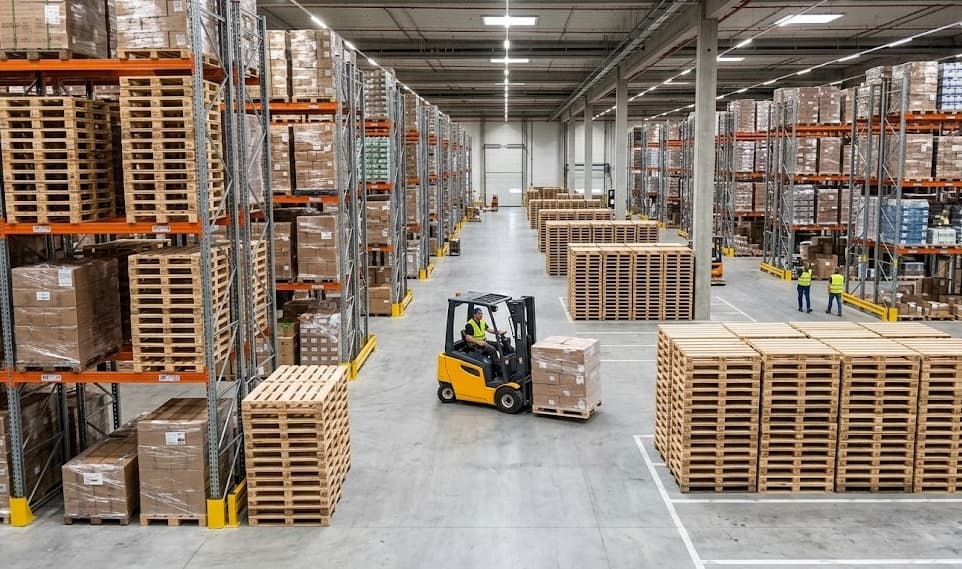
The pallet industry is a $30 billion global market that touches virtually every physical product in the supply chain, yet it rarely makes headlines. That is changing. A convergence of labor shortages, environmental regulations, technology adoption, and raw material volatility is reshaping how pallets are manufactured, managed, and recycled. For businesses that depend on pallets — which is nearly every manufacturer, distributor, and retailer — understanding these trends is essential for controlling costs and staying competitive.
At Phoenix Pallet Recycling, we operate at the intersection of these forces every day. Here are the five most significant trends we see shaping the pallet industry in 2025 and what they mean for your business.
Trend 1: Automation in Pallet Manufacturing and Repair
The pallet industry has historically been one of the most labor-intensive sectors in wood products manufacturing. Building and repairing pallets involves repetitive physical tasks — nailing boards, flipping heavy assemblies, stacking finished units — that are physically demanding and increasingly difficult to staff.
Automated and semi-automated nailing systems have been available for decades, but 2025 is seeing a new wave of robotics enter pallet facilities. Robotic pallet disassemblers use vision systems to identify nail locations and remove boards without splitting them, dramatically increasing the recovery rate for reusable lumber. Automated sorting systems use dimensional scanners and weight sensors to classify pallets by size, grade, and condition in seconds rather than minutes.
The economic case for automation is now overwhelming. With hourly labor costs for pallet workers exceeding $18 in most markets and turnover rates above 50% annually, a robotic system that replaces two full-time positions can pay for itself in 18 to 24 months. For customers, automation means more consistent quality, faster turnaround, and more predictable pricing even as labor markets remain tight.
Trend 2: Sustainability Mandates and ESG Reporting
Environmental, Social, and Governance (ESG) reporting is no longer a voluntary exercise for large corporations. The SEC's climate disclosure rules, the EU's Corporate Sustainability Reporting Directive (CSRD), and similar regulations in other jurisdictions are requiring thousands of companies to measure, report, and reduce their supply chain emissions — including the emissions embedded in their packaging materials.
Pallets are a significant line item in Scope 3 emissions calculations. A company using 50,000 new pallets per year generates approximately 1,445 metric tons of CO2-equivalent emissions from pallet production alone. Switching to recycled pallets can reduce that figure by 80% — an easy win for sustainability teams looking for high-impact, low-cost emission reductions.
We are seeing a direct increase in demand from companies that specifically request recycled pallets for sustainability reporting purposes. Many now require documentation of the recycled content percentage, carbon savings per pallet, and landfill diversion rates — metrics that reputable recyclers like Phoenix Pallet Recycling can readily provide.
Trend 3: Lumber Price Volatility and Its Ripple Effects
Lumber prices have been on a rollercoaster since 2020. The pandemic-era spike saw framing lumber exceed $1,700 per thousand board feet — nearly four times the historical average. While prices have retreated from those extremes, they remain elevated and unpredictable, driven by housing starts, mill capacity changes, trade policy, and natural disasters affecting timber supply.
Pallet lumber — typically lower-grade material than framing or furniture lumber — follows the same market dynamics but with its own supply-demand pressures. When housing construction booms, sawmills prioritize high-value framing lumber, and the supply of pallet-grade material tightens. When housing slows, more low-grade lumber becomes available for pallet production, and prices moderate.
For pallet buyers, this volatility makes recycled pallets increasingly attractive as a price-stabilization strategy. New pallet prices are directly tied to lumber markets and can swing 20 to 40 percent within a single year. Recycled pallet pricing, while not immune to market forces, is significantly more stable because the primary input — recovered wood — does not fluctuate with commodity lumber markets. Locking in supply agreements with a reliable recycler provides budget predictability that new pallet purchasing cannot match.
Trend 4: RFID, IoT, and Pallet Tracking Technology
The idea of tracking individual pallets through the supply chain is not new, but the technology has finally reached a price point and reliability level that makes it practical for mainstream adoption. RFID tags that cost less than $0.10 each can be embedded in pallet blocks or stapled to stringers, enabling automated identification at dock doors, conveyor checkpoints, and warehouse gates.
The value proposition goes beyond simple location tracking. RFID-enabled pallet management systems can automatically count pallet inventories, track trip counts to predict maintenance needs, identify pallets that have been in circulation too long and should be retired, and reconcile pallet balances between trading partners to reduce disputes over lost or unreturned assets.
More advanced IoT solutions add sensors for temperature, humidity, shock, and tilt — turning the pallet itself into a condition monitoring platform for the products it carries. While these sensor-equipped pallets are still primarily used for high-value pharmaceutical and food cold chain applications, costs are dropping rapidly. Within five years, basic environmental monitoring may become standard on pallets carrying temperature-sensitive goods.
Trend 5: Industry Consolidation and Regional Specialists
The pallet industry has traditionally been highly fragmented, with thousands of small family-owned operations serving local markets. That structure is changing. Private equity firms and large pallet companies have been on an acquisition spree, rolling up regional players to build national networks with centralized purchasing, standardized quality systems, and unified sales platforms.
This consolidation creates both opportunities and risks for pallet buyers. National companies can offer multi-location supply agreements and consistent grading standards across geographies. But they also tend toward rigid pricing structures, minimum order requirements, and slower response times than local operators.
Regional specialists like Phoenix Pallet Recycling offer a compelling alternative: deep knowledge of the local market, flexible service terms, rapid response to urgent orders, and the personal accountability that comes with an owner-operated business. As the industry consolidates around us, our competitive advantage becomes sharper — we can do things that large national chains simply cannot, like deliver 200 custom-size pallets on 24 hours' notice or adjust pickup schedules week by week as a customer's production volume fluctuates.