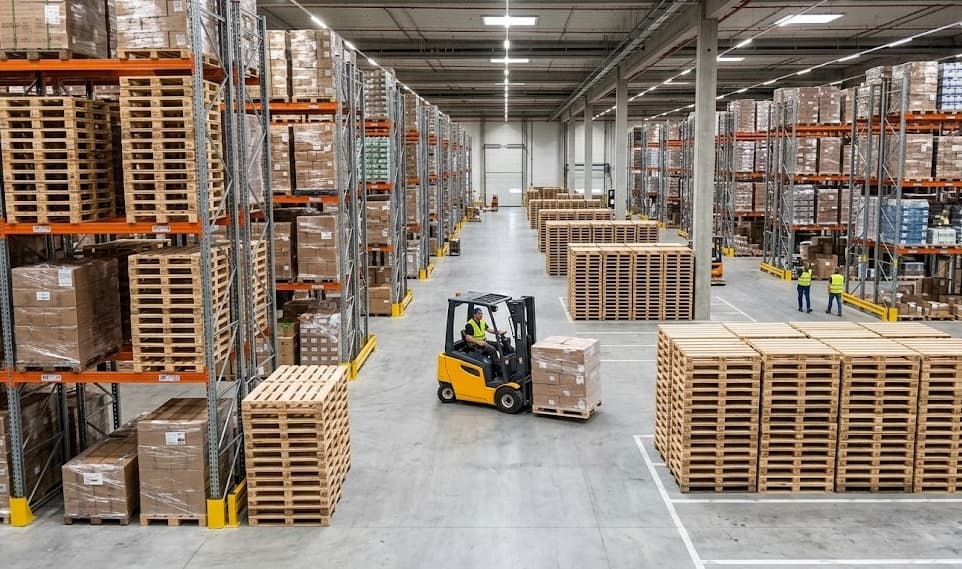
Most people see a used pallet and think "trash." What they do not see is the sophisticated, multi-step process that transforms battered, broken wood into a fully functional shipping platform ready for another round of service. The pallet recycling industry processes over 450 million pallets per year in the United States alone, making it one of the most successful material recovery operations in the entire supply chain.
At Phoenix Pallet Recycling, we handle thousands of pallets every week through our facility. Each one passes through a structured workflow designed to maximize recovery, minimize waste, and deliver a finished product that meets the same performance specifications as a new pallet at a fraction of the cost and environmental impact. Here is exactly how it works.
Step 1: Collection and Pickup
The recycling process begins at the source — warehouses, distribution centers, retail stores, manufacturing plants, and construction sites. Businesses accumulate used pallets as they unload incoming freight, and those pallets need to go somewhere. Without a recycling partner, they pile up in loading docks, take up valuable warehouse space, and eventually end up in dumpsters.
Our collection fleet operates on scheduled routes throughout the Phoenix metropolitan area and greater Arizona. We pick up pallets in quantities ranging from a few dozen to full truckloads of 400 or more. For high-volume accounts, we provide dedicated trailers that remain on-site for continuous loading, with swap-outs scheduled at regular intervals.
Many businesses are surprised to learn that pallet recyclers will actually pay for used pallets in good condition. The purchase price depends on the pallet size, grade, and current market conditions, but it transforms what most companies consider a disposal cost into a revenue stream. Even pallets in poor condition are typically picked up at no charge, saving the generator the cost of waste hauling.
Step 2: Sorting by Size and Type
When pallets arrive at our facility, the first task is sorting. The pallet world is far more diverse than most people realize. While the 48x40-inch GMA pallet dominates the grocery and consumer goods industries — accounting for roughly 30% of all pallets in circulation — there are dozens of other standard sizes used across different sectors.
Automotive manufacturers use 48x45 pallets. Chemical companies prefer 42x42. The beverage industry often uses 48x48 or 36x36 sizes. European imports arrive on 800x1200mm Euro pallets. Our sorting team separates incoming pallets by dimension, construction style (stringer vs. block), and wood species, because each category has different repair requirements and market values.
Sorting also separates pallets by condition into three streams: reusable as-is, repairable, and dismantle-only. This triage step is critical for efficiency — it ensures that pallets in good condition move directly to quality inspection without wasting time on the repair line, while severely damaged pallets go straight to dismantling for parts recovery.
Step 3: Quality Inspection
Every pallet that enters the reusable or repairable stream undergoes a thorough inspection. Our inspectors evaluate each pallet against industry-standard grading criteria, checking for structural integrity, board condition, fastener quality, and dimensional accuracy.
Key Inspection Criteria
Pallets that pass inspection with no defects are graded, stacked, and moved to finished inventory. Those with repairable defects are tagged with the specific repairs needed and sent to the repair station. Pallets that fail inspection due to structural compromise, contamination, or non-standard construction are routed to dismantling.
Step 4: Dismantling and Repair
Pallet repair is where skilled craftsmanship meets industrial efficiency. Repair technicians replace broken or missing deck boards, reinforce cracked stringers with companion boards, replace damaged lead boards, and re-nail loose components. The goal is to restore the pallet to a condition where it performs identically to a new unit under normal loading conditions.
The replacement lumber used in repairs comes from two sources. First, boards recovered from dismantled pallets that cannot be repaired as whole units — a single pallet beyond repair might yield six or eight perfectly good boards that extend the life of other pallets. Second, new lumber cut to specification for components that cannot be sourced from recovered stock.
This parts-recovery approach is what makes pallet recycling so resource-efficient. Even a pallet that is too damaged to repair as a unit rarely goes entirely to waste. Its individual components — boards, stringers, blocks — are harvested and used to bring other pallets back to full service. On average, our facility recovers usable components from over 95% of all pallets we receive.
Step 5: Grading and Redistribution
Once repaired and re-inspected, pallets are graded according to industry standards — typically as Grade A (premium, like-new appearance), Grade B (fully functional with cosmetic wear), or economy grade (sound structure, significant visual wear). Each grade serves a specific market segment.
Finished pallets are stacked on our yard in uniform lots, organized by size and grade, ready for delivery. Our sales team matches available inventory to customer orders, and our delivery fleet distributes pallets throughout the region. High-volume customers receive scheduled deliveries timed to their production schedules, ensuring they always have the pallets they need without excess inventory consuming floor space.
The entire cycle — from collection to redistribution — typically takes three to five business days. That speed is essential because pallets are a just-in-time commodity. A manufacturer cannot wait two weeks for pallets when they have product ready to ship today. Our process is designed for the rapid turnaround that modern supply chains demand.
Step 6: Mulching and Material Recovery
Not every piece of pallet wood can be reused in pallet form. Boards with severe rot, chemical contamination, or excessive splitting cannot safely be used in a load-bearing application. But even this material has value. We process end-of-life pallet wood through industrial grinders that reduce it to wood chips and mulch.
This ground wood finds multiple second lives. Landscaping mulch is the most visible use — the colored mulch in commercial landscaping beds is often made from recycled pallet wood. Other applications include animal bedding, biomass fuel for industrial boilers, compost feedstock, and raw material for engineered wood products like particleboard.
The key principle is zero waste. Through a combination of reuse, repair, component recovery, and material grinding, a well-run pallet recycling operation diverts virtually 100% of incoming wood from the landfill. At Phoenix Pallet Recycling, our landfill diversion rate consistently exceeds 98%.