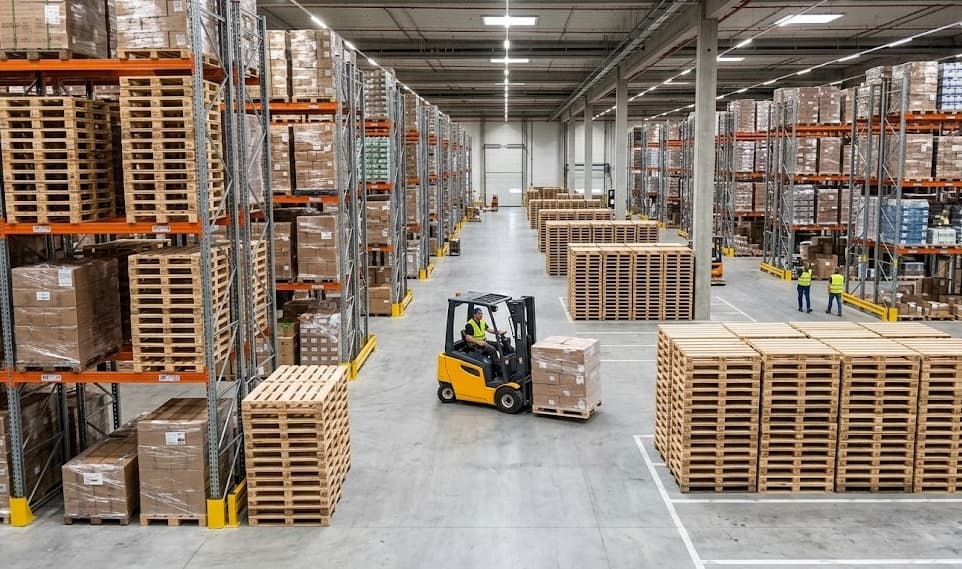
Supply chain carbon emissions are under more scrutiny than ever before. Customers, investors, and regulators are all asking the same question: what are you doing to reduce your environmental impact? For companies that move physical goods, one of the most overlooked opportunities for meaningful carbon reduction is pallet management. The pallets that carry your products through the supply chain represent a surprisingly significant source of emissions — and switching to recycled pallets is one of the simplest changes you can make to shrink your carbon footprint.
Understanding Scope 3 Emissions in Your Supply Chain
Carbon emissions are categorized into three scopes. Scope 1 covers direct emissions from your own operations — fuel burned in company vehicles, natural gas used in your facilities. Scope 2 covers indirect emissions from purchased electricity. Scope 3 covers everything else in your value chain: the emissions generated by your suppliers, transportation providers, and the production of materials you purchase.
For most businesses, scope 3 emissions account for 70% to 90% of their total carbon footprint. Pallets fall squarely into scope 3 because they are purchased goods used in upstream and downstream logistics. Every new wooden pallet represents trees that were harvested, lumber that was transported to a mill, boards that were cut and dried using energy-intensive kilns, and finished pallets that were shipped to you. Each step generates emissions that land on your scope 3 ledger.
Emission Scopes at a Glance
Direct emissions — company vehicles, on-site fuel
Typical share: 5-10%
Purchased electricity and heating
Typical share: 10-15%
Supply chain, purchased goods, logistics, pallets
Typical share: 70-90%
Lifecycle Analysis: New Pallets vs. Recycled Pallets
A lifecycle analysis (LCA) measures the total environmental impact of a product from raw material extraction through disposal. When you compare the lifecycle of a new wooden pallet against a recycled pallet, the carbon difference is substantial.
Manufacturing a single new 48x40 GMA pallet generates approximately 28 to 35 kg of CO2 equivalent emissions. This includes forestry operations, sawmill processing, kiln drying, assembly, and transportation to the end user. The majority of these emissions come from two steps: kiln drying the lumber (which requires burning natural gas or biomass at sustained high temperatures) and transporting raw materials and finished pallets between facilities.
A recycled pallet, by contrast, generates only 8 to 12 kg of CO2 equivalent emissions. The recycling process involves collecting used pallets, inspecting and sorting them, replacing damaged boards where necessary, and delivering them to customers. There is no forestry, no sawmill processing, and no kiln drying. The carbon savings are immediate and measurable.
Carbon Emissions per Pallet (kg CO2e)
Recycled pallets produce up to 66% fewer carbon emissions per unit compared to new pallets.
The Multiplier Effect: Scaling Carbon Savings
The per-pallet carbon savings become significant when multiplied across annual volumes. Consider a mid-sized distributor that uses 10,000 pallets per year. By switching from new to recycled pallets, that company eliminates roughly 200,000 kg of CO2 equivalent emissions annually — the same as taking 43 passenger vehicles off the road for a full year.
Annual volume
1,000/year
4 cars off the road
Annual volume
10,000/year
43 cars off the road
Annual volume
50,000/year
217 cars off the road
For large enterprises using hundreds of thousands of pallets, the carbon reduction from recycled pallets can represent one of the single largest scope 3 reduction initiatives available — and it requires no capital investment, no process changes, and no disruption to operations.
Beyond Carbon: Additional Environmental Benefits
Carbon reduction is the headline benefit, but recycled pallets deliver broader environmental advantages as well. Each recycled pallet extends the useful life of the wood it contains, keeping that material out of landfills and reducing the demand for virgin timber. The US produces roughly 500 million new pallets each year, consuming about 4.5 billion board feet of hardwood and softwood lumber. By recycling existing pallets instead of manufacturing new ones, we directly reduce the pressure on forests and the ecosystems they support.
Recycling also reduces water consumption (sawmills use significant amounts of water for log washing, dust suppression, and cooling), air pollution from sawmill operations, and the energy consumption associated with kiln drying. Every pallet that gets a second, third, or fourth life represents resources that did not need to be extracted from the environment.
Actionable Steps to Reduce Your Pallet Carbon Footprint
Reducing the carbon footprint of your pallet operations does not require a complete overhaul. Here are concrete steps you can implement starting today:
Audit Your Current Pallet Usage
Count how many new pallets you purchase annually, how many you discard, and how many trips each pallet makes. This baseline data is essential for measuring improvement.
Switch to Recycled Pallets Where Possible
Identify shipments that do not require brand-new pallets. Most domestic freight, warehouse storage, and internal transfers work perfectly well on Grade A or Grade B recycled pallets.
Establish a Pallet Return Program
Work with your customers and logistics partners to return pallets for reuse rather than discarding them. Phoenix Pallet Recycling can help design a buyback program that works for your operation.
Track and Report Your Savings
Document the number of recycled pallets purchased and calculate the avoided emissions using lifecycle data. Include these figures in your sustainability reports and ESG disclosures.
Partner with a Local Recycler
Shorter transportation distances mean lower emissions. Working with a regional recycler like Phoenix Pallet Recycling keeps your pallets — and your carbon savings — local.