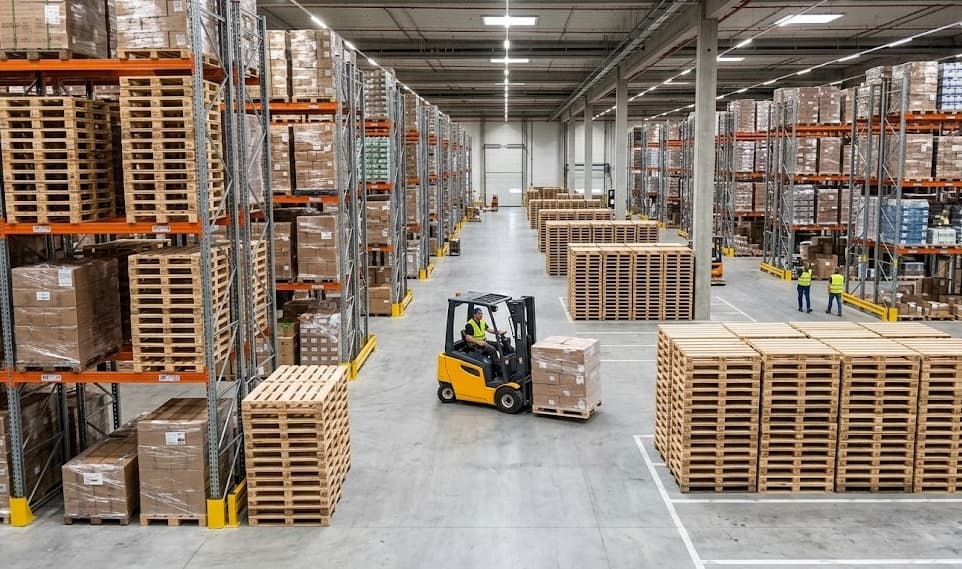
The pallet recycling industry has traditionally been a labor-intensive business. Workers manually inspect each pallet, assess its condition, sort it by grade, and route it for repair or resale. This process works, but it is slow, physically demanding, and subject to human variability. A pallet that one worker grades as a B might be graded as a C by another. Now, automated sorting technology is transforming how recyclers process pallets — increasing throughput, improving grading consistency, reducing labor costs, and enabling the kind of precision that manual operations simply cannot match. Here is how these technologies work and what they mean for the industry.
Optical Sorting: Seeing What Human Eyes Miss
Optical sorting systems use high-resolution cameras, laser scanners, and structured light sensors to capture detailed three-dimensional images of each pallet as it moves along a conveyor line. These systems can measure board thickness, detect cracks and splits, identify missing components, measure dimensional accuracy, and assess surface condition — all in a fraction of a second.
Modern optical systems process pallets at speeds of 15 to 30 pallets per minute, compared to 4 to 8 pallets per minute for an experienced manual inspector. The speed improvement alone represents a 3x to 4x increase in throughput. But the real advantage is consistency. An optical system applies exactly the same criteria to pallet number 1 as it does to pallet number 10,000. There is no fatigue, no distraction, and no subjective interpretation.
Optical Sorting Capabilities
Dimensional Measurement
Measures pallet length, width, and height to +/- 2mm accuracy. Detects out-of-spec pallets that would cause problems in automated warehouses.
Board Integrity Analysis
Identifies cracks, splits, holes, and missing boards using 3D surface scanning. Can detect defects as small as 3mm wide.
Fastener Detection
Locates protruding nails, missing fasteners, and improperly driven staples using laser profiling.
Stain and Contamination Detection
Color cameras identify chemical stains, mold, and foreign material contamination that may not be visible to the naked eye.
AI-Powered Grading: Machine Learning Meets Pallets
While optical systems capture the physical data, artificial intelligence is what makes sense of it. Machine learning models trained on hundreds of thousands of pallet images can classify pallets into grades (A, B, C, or scrap) with accuracy rates exceeding 95%. These models learn the subtle patterns that distinguish grade levels — patterns that are difficult to articulate in a written specification but that an AI system can recognize consistently.
The AI grading process works by feeding the optical scan data into a neural network that has been trained on a labeled dataset of pallets whose grades were confirmed by experienced human inspectors. The model learns to associate specific combinations of damage patterns, wear levels, and dimensional measurements with each grade. Once trained, the model can grade pallets in real time as they move through the sorting line.
Grade A
Minimal wear, all boards intact, dimensionally accurate, no structural damage, clean surface
AI classification accuracy
Grade B
Moderate wear, minor board damage acceptable, may need 1-2 board replacements, functionally sound
AI classification accuracy
Grade C
Heavy wear, multiple board issues, may need stringer repair, suitable for heavy or non-retail use
AI classification accuracy
One of the most valuable aspects of AI grading is its ability to improve over time. As the system processes more pallets and receives feedback from quality control checks, the model continues to refine its accuracy. This continuous learning loop means that AI-graded pallet quality gets more consistent the longer the system operates.
Conveyor Systems: The Physical Infrastructure
Optical sorting and AI grading are only useful if pallets can be physically moved through the inspection zone and routed to the correct destination efficiently. Modern pallet sorting facilities use integrated conveyor systems that automate the entire flow from intake to sorted output.
A typical automated sorting line consists of an infeed conveyor where pallets are loaded (either manually or by forklift), a scanning station where optical sensors and cameras capture pallet data, a decision point where the AI system assigns a grade and routing instruction, and a divert system that physically routes each pallet to the appropriate output lane. Output lanes are organized by grade, size, or destination (repair, resale, scrap).
Infeed Station
Pallets are placed on the conveyor by forklift or hand. Some systems use automated de-stackers to feed pallets from stacked positions. Throughput starts at the infeed rate.
Scanning Zone
High-speed cameras, laser scanners, and weight sensors capture dimensional, surface, and structural data in under one second per pallet. The scanning zone is typically enclosed to control lighting conditions.
Decision Engine
The AI model processes scan data in real time and assigns each pallet a grade, a routing code, and (optionally) a repair prescription listing which boards or components need replacement.
Divert Gates
Pneumatic or electric divert gates push pallets onto the correct output lane based on the AI routing decision. Modern systems support 6 to 12 output lanes for maximum sorting granularity.
Output Lanes
Sorted pallets accumulate in grade-specific lanes where they are stacked by forklift or automated stacking systems for storage, shipment, or transfer to the repair line.
Labor Savings and Return on Investment
The economic case for automated sorting is compelling. A manual sorting operation typically requires 3 to 5 workers to achieve a throughput of 300 to 500 pallets per hour. An automated system can achieve 800 to 1,500 pallets per hour with 1 to 2 operators. The labor reduction alone can generate annual savings that justify the capital investment within 18 to 36 months for high-volume operations.
Manual vs. Automated Operation Comparison
Throughput
3-4x fasterLabor Required
60-70% reductionGrading Consistency
Significant improvementData Capture
Full traceabilityInjury Risk
Safer workplaceBeyond direct labor savings, automated sorting reduces costly grading errors. When a Grade B pallet is incorrectly graded as a C, it sells for less than its true value. When a C is graded as a B, the customer receives lower quality than expected. Both scenarios cost money and damage trust. Automated grading eliminates these errors, improving both revenue accuracy and customer satisfaction.
What This Means for Pallet Buyers
As pallet recyclers adopt automated sorting technology, customers benefit in several tangible ways. First, the pallets you receive are graded more consistently, meaning the quality you expect is the quality you get. Second, recyclers who invest in automation can often offer more competitive pricing because their processing costs are lower. Third, faster sorting means shorter lead times — your orders are processed and shipped more quickly.
At Phoenix Pallet Recycling, we invest continuously in technology and process improvements to deliver the best possible product to our customers. Whether you need Grade A pallets for retail applications or Grade B pallets for warehouse use, our sorting and inspection processes ensure that every pallet meets the specifications for its grade.
The pallet industry is evolving. Companies that embrace technology — from sorting automation to data-driven inventory management — will deliver better products at lower costs. For pallet buyers, this means better value, more reliable supply, and a partner who is investing in the future of the industry. Learn more about our commitment to quality and how we deliver consistent, reliable pallets to businesses across the region.